
 It is emerging that many local and international investors were cheated into buying shares in the recently concluded East Africa's largest ever Initial Public offering (Safaricom IPO). The company recently issued a revised Safaricom prospectus raising eyebrows as it borders on reneging on a sworn affidavit that's binding. Read More CLICK HERE
Wednesday, April 30, 2008
Investors Cheated into buying Kenya's Safaricom shares in IPO

Sunday, April 20, 2008
Cheetah Index Interviews the Director of Business Action for Africa

Excerpt from the interview between the Cheetah Index and Zahid Torres-Rahman, Director, Business Action for Africa.
"Below is the interview with Mr. Zahid Torres-Rahman.
Please tells us a little bit about your personal story and how you became involved in this endeavor?
Ever since my time as a teacher in Zimbabwe in the late 80s, I have been passionate about Africa. After a career in the private sector, I joined the UK Government and ultimately joined UK Prime Minister Blair's Commission for Africa to head the work of economic growth and private sector development. 2005 was an exciting time for those of us wanting to support African-led development. But for me there were three things very wrong with the headlines on Africa at the time.
First, the non-government organizations, while very successful in raising Africa high up the policy agenda, were missing a big part of the story. In focusing on aid and debt relief, hardly any attention was being paid to the priorities of Africans themselves: the opportunity to get jobs, grow their businesses and trade in a fair world market.
Second, Africa was being portrayed as if it were one country on the brink of disaster. In fact the Africa that any one who knows Africa will tell you about, is one of huge diversity and immense opportunity, the role of business as the drivers of long-term growth and poverty reduction had been all but written out of the story.
We set up Business Action for Africa (www.businessactionforafrica.org) as an informal network of businesses, business organisations and development partners to take action on these fronts – to provide an alternative voice on the policies needed to make poverty history; to promote a more balanced view of Africa; and to showcase and promote the role of business in delivering positive change for Africa and its people.
So how exactly does doing business in Africa help to improve living conditions on the continent and where does Business Action for Africa fit into this conversation?
Nearly all poor people are in the private sector: as producers or employees - whether this is in small family farms and small businesses or as part of the supply chain of a large multinational. In a survey of 60,000 poor people published back in 2000, the majority saw self-employment, getting a job or starting a business as the best way to escape poverty. That is, poor people themselves see business as integral to their strategies for improving their living conditions.
Business Action for Africa tells this story and calls on governments and international donors to help small businesses grow. We also showcase the role that larger national and international companies can play in fighting poverty through their core business: creating jobs, building opportunities for small businesses as suppliers and distributors, developing products and services that meet the needs of poor people, and paying taxes that then go on to fund social spending.
When did you begin to see the organization's efforts yield fruit both in terms of achieving the main three objectives of Business Action for Africa and with respect to attracting some of the corporate sponsors that you have? Was there ever a time when you felt like this journey would be an uphill battle?
The focus of Business Action for Africa is to catalyze business-led collective action. In addition to our advocacy work and best-practice sharing, we have supported a number of projects on the ground. One of these is called Business Action Against Corruption. BAAC is founded on the view that change requires indigenous and international private sector actors to find practical ways to collaborate with governments to tackle corruption. Led by organizations like Royal Dutch Shell, the Commonwealth Business Council, and Southern Africa Forum Against Corruption, there are now programmes running in Botswana, Cameroon, Malawi, Nigeria and Zambia."
Of course, I love your comments. But, if you can't comment at this particular time- but would like to let us know that you were here; please sign and View my guestbook
Thursday, April 17, 2008
Africa’s Looming Food Crisis can be Mitigated
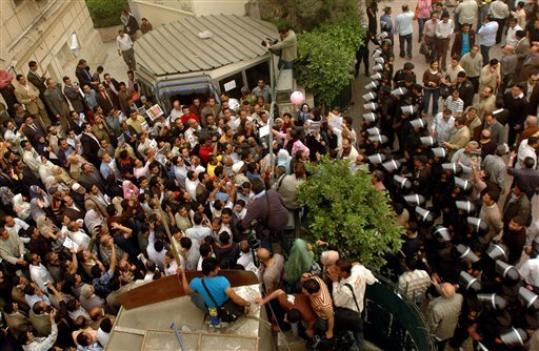 Images of rioters in Egypt, Senegal, Cameroon, Burkina Faso and Mozambique (among others) clashing with police in protest against soaring food prices and Kenya’s abandoned internally displaced people all tell a similar story: Africa needs to ...........Click to Read MORE
Monday, April 14, 2008
Profile: Kenya's new PM Raila Odinga
 Raila Odinga, the 63-year-old newly appointed Kenyan prime minister, is described by both friends and foes as the engine that drives politics in Kenya.
Odinga was born in January 1945, in Maseno, Nyanza Province of Kenya, the second son of nine children of the late Jaramogi Oginga Odinga, who was Kenya's vice-president and doyen of opposition.......READ MORE
Thursday, April 03, 2008
HOST Africa: New Hospitality News and Information Magazine born in Africa
 HOST Africa is the latest magazine offering a new approach to the hospitality industry news, information and analysis in East Africa. The magazine set to go out in June is already testing its new website VIEW HERE
It is published by All Times Media Kenya, and will be distributed exclusively via suscription to Top industry decision makers in the hospitality industry (Airlines, Hotels, Restaurants, Industry Suppliers, Business Travellers). Copies of the magazine will also retail at major newstands throughout East Africa and parts of South Africa, the US and Europe. you can suscribe to recieve exclusive copies of HOST Africa magazine through this blog CLICK HERE
Friday, March 28, 2008
Kenya's Largest IPO opens amid protests over Rogue Stockbrokers

Rogue stockbrokers, not the electronic trading system, are to blame for the financial crisis facing Nyaga Stockbrokers and other ills afflicting the Kenyan stock market.CLICK TO READ MORE.......
Wednesday, March 19, 2008
Here is a chance to participate in a global writing competition
 Do you have the ability to be a top-notch journalist? Could you write the sort of articles that can be published in international press?
Click Here to participate in an international writing competition to stand a chance for your work to be published alongside some of the best journalism in the UK plus computing equipment worth $1500. ENTER HERE
Monday, March 17, 2008
Rush to sell Safaricom raises moral questions
 With all indications showing that a large number of small investors are likely to be locked out of the forthcoming Safaricom sale, the spotlight must turn to Finance minister Amos Kimunya over his timing of this offer that is billed as East Africa’s biggest.....CLICK HERE for the rest of the story
Friday, February 15, 2008
Post Election Kenya: No Need to Re-Invent the Wheel
| ||||||||||
|


Of course, I love your comments. But, if you can't comment at this particular time- but would like to let us know that you were here; please sign and View my guestbook
Thursday, January 31, 2008
Kenya up in smoke as Britain, USA, EU, UN, AU and EAC watch from a distance
 The world risks loosing over 33 million people in Kenya’s post election violence that has rocked the country over the past one month. The European Union, The commonwealth and the African Union raised concerns that presidential vote tallying was deeply flawed and fell short....READ MORE
Koffi Annan's Peace Mission doomed to fail as Another Kenyan Oposition MP killed in cold blood
Another opposition (ODM) MP has been killed in Kenya, as violence continues over last month's disputed election. David Kimutai Too was shot dead Thursday and his body taken to Moi Teaching and Referal Hospital. The man was shot dead in the western town of.....READ MORE
Kenya's Collapse
 A rigged election, ethnic violence, economic dysfunction and now a political assassination -- the crisis in Kenya has hit a sad superfecta. Worse, the politicians who loosed these forces don't look capable of reining them back in.
It's been a month since.......READ MORE
Wednesday, January 30, 2008
The Situation in Kenya is So Sad (Warning: Contains Very Disturbing Pictures)
 There is a very grave situation in Kenya at the moment that calls for international support to end violence that has rocked the country over the past one month. Just Yesterday, a Kenyan Lawmaker was killed fuelling READ MORE
Monday, January 28, 2008
Freedom in the World 2008: Global Freedom in Retreat (Kenya among the Worst Perfomers)
 The year 2007 was marked by a notable setback for global freedom, Freedom House reported in a worldwide survey of freedom released today. Kenya is now being pronounced in the same breath as the Lawless Somalia among other unstable countries....READ MORE
Tuesday, November 06, 2007
Happy Birthday Africa Ready for Business!
I just noticed that this blog has now passed the one year mark.
It is my hope that you have enjoyed this 1st year of blogging on Africa Ready for Business. What we have tried to do here is to illustrate how Africa's free market economies have been on the rebound and are providing the means for their respective groups of citizens to empower themselves to achieve their needs and wants. I hope that this is what we have done.
As for how blogging has the last year of my life...The differences between the "before " and "after" for me have been quite stark. Prior to blogging my personal mission was the same as it is today but my daily activities were, for the most part, out of line with my goals. Where the change is even more evident is in my rolodex. If you had seen it a year ago it would have looked like the rolodex of someone who was all over the board, so to speak. But today there is a more of a specific type of a profile within my contact list-there are more professionals on the other end who are already doing business in or within the African continent or they might like to, than not. This means a lot to me. For that I have you, the reader, to thank-thank you!
My dream for this blog has been to make it a platform for multiple bloggers( a group blog) to be able to post stories on entrepreneurship in Africa. We managed to find a stellar writer in Branded, however, overall we haven't fared well in this category. But maybe in the big scheme of things it's ok-because within a few days I will be unveiling such a platform and it will be published on a different system alltogether. So, we would like your opinions on what you'd like to see more of this year from this blog. Please let us know what you might like more of in the upcoming year. In summary the year has been great-thank you all!
Of course, I love your comments. But, if you can't comment at this particular time- but would like to let us know that you were here; please sign and View my guestbook
Friday, October 19, 2007
Is the Kenyan Finance Minister in the middle of a Dirty Economic Game????
 The Kenyan finance minister is showing great signs of underhand economic mischief specifically because of an impending major IPO (Initial Public Offer) of Safaricom, a mobile phone service. Apparently, he is so determined to get into the books of history as the man who pulled off a deal worth over 34 Billion Kenya Shillings. With the country's elections just weeks away you may be forgiven for assuming that this is just a ploy to get money to fund the elections given that the incumbent is faring not so well in recent opinion polls that put him at 37% against his major challenger who gannered 53%. May be best way would be................[Read the rest of the post HERE ]
Tuesday, October 16, 2007
5th Carnival of African Enterprising [part 2]
 In the last part of The Carnival of African Enterprising we present more views from bloggers about Africa in the 21st Century.
Speaking on “AfricanPath”, Jeffery Kimathi marketing manager of “an African fashion” company based in New York-USA, advices Africans to follow his business model that allows customers to subtly and stylishly speak messages that showcase the vibrancy and diversity of the African continent. Kimathi believes that Africa has the capacity to solve its own problems because no one understands the continent better than Africa itself. It’s all about passion and hard work; there is no elevator to success and Africa has to take the stairway just like everyone else. He advises Africans to strive to earn respect for their resourcefulness, ideas, and creativity. According to him Africa should endeavor to contribute to the modern world culture. “This is why Italian handcrafted garments go for thousands of dollars each and yet similar quality handcrafted African goods usually go for much less,” he says
“Joshua Wanyama” believes that any business is only as valid as its value in the eyes of a consumer. This also holds true for African businesses. He advises Africa to aim at creating a prominent global brand by strategically building a position within the mind of the consumer (world) and steadily defending that position. If a company offers Internet connectivity in Cairo, Egypt it can do the same in Bujumbura, Burundi as long as a market exists. For it to develop a strong position within the marketplace, it has to develop a strong brand. The name this company occupies in the Egyptian marketplace has to be the same as the one occupied in a Burundian’s mind or a Togolese for that matter. Branding then presents a strong foundation on which Africa can build its market share in a vibrant global economy. “Wanyama” believes that a Pan-African company will also need to have a home country, for example, Coca Cola (an American soft drink company) is a global brand with 80% of its annual sales coming from foreign markets, it will be ill advised to disown its American heritage.
According to “Benin Mwangi” Africans should re-orient their thinking, step out of the past and see markets as what they are - big and underserved. Benin proposes a public-private approach as one way to take Africa into the 21st Century. If an African government intends to invest in wiring classrooms and has both the scale and technical savvy to pull it off, that’s great. However, if the private sector has the muscle to do it much better, then the government should support the sector by allowing such investments but still play its role as a facilitator.
“David” advises African businesses to adopt better business strategies so as to attract more investors. He reckons that Africa should carefully strengthen all aspects of business that investors look for to ensure that the opportunities Africa present achieve results. For a successful business, he advises Africans to put more strength in what investors look for when evaluating opportunities which include; the people who manage the company, concept value, price of the deal, deal structure and the exit strategy.
Thursday, October 11, 2007
The Carnival of African Enterprising [Part 1]
 This is the first part of the 5th Carnival of African Enterprising presenting views of bloggers based on the theme Positioning Africa in the 21st Century. This edition was first published in The African Executive on 10th October 2007. The second part will be presented on the 17th of October 2007.
According to Timothy Kioko, Positioning is the aggregate perception that people (target market) have of a particular continent (product) in relation to competitors in the same category. A country like India is positioned as a business outsourcing hub; China on the other hand, is growing super fast as a major force in the international trade arena and is in the process of positioning itself as a major trading partner in Africa. Saying that Africa is already positioned as the highest recipient of foreign aid, he advises the continent to re-position itself as a business hub by embracing democracy, efficiency, respect of property rights and encourage innovation. Africa should not sleep as the other regions take over the world!
Kenyanomics holds that adopting sound economic policies that encourage economic freedom will lead to economic prosperity. He adds that obsession with poverty eradication is a major threat to economic freedom in developing nations as it increases central planning and crowds out individual effort. Kimani argues that the United Nations' Millennium Development Goals (MDGs) only serve to widen avenues of corruption and increased budget imbalances, both of which have crippled Third World economies for decades.
Randy Nichols believes that developing a market based education system that encourages careers in business will boost the continent in its bid to position itself as a source of international labor. Experiential knowledge gained from such labor exports will form an integral part in Africa’s development. He advises Africa to embrace any opportunity to get training in fields that will see its marketability soar to greater heights.
According to Gustav S going to university does not mean that one is highly educated. Many Africans believe that the only way to achieve goals in life is to go to school, learn a profession and then get employment. Becoming a professional, going to the University or taking required steps to land your desired job are important but it is just the beginning of one’s way to success. He urges Africans to develop Discipline, Self Control, Consistency, Perseverance and Faith in order to move forward as a continent.
Finally, G. Kofi Annan says that the continent needs to develop its own film and broadcasting industries with focus on local content. By producing local themed movies in the “right way” we can better present African in the international media. In his opinion, one of the ways that will change the process of making African films for Western audiences is to tie the African film industry to the strong African-American film community. While the film industry at large struggles to make a return on the production costs, with blockbusters not making the numbers they used to, the African-American film community has a great opportunity to align with the African film community and continue to grow professionally and financially. But creativity and authenticity is the real key.
Monday, October 01, 2007
Nana Kwodo Amoa I (August 5, 1947-September 29, 2007)
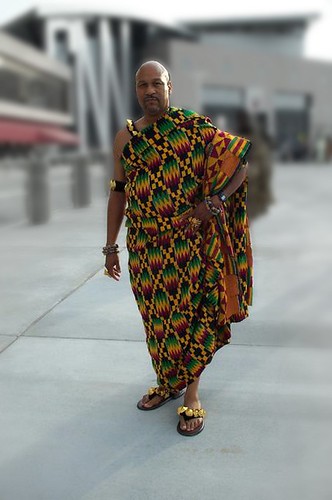
Dr. Charles S. Brown
Dr. Charles S. Brown grew up at a pivotal time for Black America. As a young student at Morehouse College he was able to witness and be a part of America's civil rights movement. After reading books written by Dr. W.E.B. Dubois and Kwame Nkrumah Dr. Brown began to become exposed to a wider perspective. Afterwards, he gradually gained an appreciation for African history. Over time this appreciation would continue to grow and less than ten years after obtaining his PhD in physics he began to research ancient African civilizations. His study was so intense that over a three year time span, he became an authority on the subject.
For Dr. Brown, learning about ancient African civilizations meant more than just being able to quote a few abstract facts, he believed that if he could help African American youth become aware of their true heritage it would be easier for them to dream big. Integrating scientific finds on these ancient civilizations into mathematics or physics curricula for his university classes would later become one of Dr. Brown's most recognizable hallmarks.
But the event that would later shape his outlook on modern Africa continent took place when he attended the First Edward Bouchet International Conference on Physics and Technology on June 11, 1988 in Trieste, Italy. The Edward Bouchet Institute is today called the Edward Bouchet Abdus Salaam Institute. One of its aims is to foster scientific and technical collaborations between African and American scientists and engineers. Prof Charles S .Brown's first trip to the African continent occurred in 1990 when he attended the second Edward Bouchet Institute Conference in Ghana. It is through the Edward Bouchet Institute that Professor Brown met the internationally renowned Professor Francis K. Allotey. In the fall of 1991, Prof. F. K. A. Allotey of Ghana visited with Prof. Charles S. Brown, who at that time was the Chairman of the Physics Department at Clark Atlanta University (CAU). The collaboration between Prof. Allotey, Prof. A. E. Bak, and Prof. C. S. Brown resulted in two published papers.
Prof. Allotey, four years later arranged the visit of Prof. Charles S. Brown to Cape Coast, Ghana, where he worked as a Fulbright Visiting Scholar (December 1995 – May 1996) and an ICTP Visiting Scholar (June 1996 – December 1996). Prof. Brown helped to develop the University’s graduate curriculum, served as a research advisor for a physics doctoral candidate, and collaborated on a research paper with Prof. S. Y. Mensah, Chairman of the Physics Department and Vice Dean of the Faculty of Science at the University. The work that Prof. Brown did in Ghana did not go unnoticed; in fact it was instrumental in his enstoolment as a traditional ruler in the Assin Manso district of Ghana.
To elders and other traditional rulers in this district Prof. Brown was known as Nana Kwodo Amoah I. It is a role that he took very seriously, even until his passing.
I love you Dad. I know you are in a better place.
Sunday, September 16, 2007
Fashion Icon Gives Hip Hop an African Story!
Kenya Urban Fashion Icon Also Teaches…

courtesy of: Jamhuri Wear
Just a little over an hour ago, I was doing a periodic tour of my page on myspace and to my surprise after visiting a few of my friends spaces landed on the myspace profile of Jamhuri Wear. The reason for my amazement is that there have been so many times that I searched for hours to find an entrepreneur like Jeffrey Kimathi(one that the youth can easily identify with) to profile on The Benin Epilogue and then by total coincidence I bump into such a person on myspace… To me Jeffrey Kimathi is the perfect embodiment of the term “cheetah” that Dr. George Ayittey made popular in his book Africa Unchained.

courtesy of: WorldChanging
Here is an excerpt on Mr. Kimathi, it is written by one of Kimathi’s friends & colleagues who also happens to be the founder and editor of KBR1963:

courtesy of: KBR1963
For the few who don’t know about the Jeffery Kimathi story or just see Jamhuri today for what it is today. A lot of thought or growth has been put into the product since its inception. In that Kim actually interned for ECKO Clothing Company after moving from Dallas a while back. A lot of people thought he was crazy to work as an intern with no cash (am sure the same people are not really saying much today). After his internship which lasted about 5 months, he was hired to work with the marketing department which was working on launching G-Unit clothing for 50 and other related brands (I guess this is the part where I say the rest is history)
Today Kim is developing his own brand, his own vision, his own clothing line that are communicating the heart, mood, soul and identity of many Africans living in the Diaspora. The clothing line represents our culture in a dignified manner and not the other brands that represent borrowed ideologies that make us look fragmented. Clothes make up who we are, they say a lot about an individual before he opens up his mouth, this would explain why majority of the artists who are into changing humanity end up coming out with a clothing line or t-shirts that make a powerful statement.
I wear Jamhuri Wear because it represents a journey of a man I can relate to, it represents a country I have learnt to love dearly, and it represents the people that I care about the most. I wear Jamhuri wear not because of Kim but because I believe I am a King in my own right. “Made to fit Kings and Queens.” If you haven’t placed an order for an item yet, please do so and look at the attention to detail in the packaging, the delivery and the handling, its these small things that demonstrate greatness and attention to detail. It’s these little things that make me a King.
Ok, so that says a little bit about the visionary behind Jamhuri Wear. But there is more, Jeffrey is also a blogger. And with what must be a non-stop, no sleep, 24-7 type schedule he still makes time to write quite a number of superb posts. He then ties some of the posts into any one of his many unique product offerings. Below is a post where he talks about a very special city in Senegal called Touba.
courtesy of: Wikipedia

Touba is the home of an astonishing group of people called the Mourides; they are renowned for their entrepreneurial prowess. This is something that they display not only in Senegal, but perhaps to an even greater extent outside of Senegal. It is Emeka Okafor who first introduced me to the Mourides. But anyhow here is an excerpt from the grandmaster of urban African Fashion:
Their “you can and should do for yourself” work ethic was inherited from Bamba himself; Mourides have developed their own financial and spiritual independence. They are not dependant upon donations from Saudi Arabia or other wealthy Islamic societies.
Touba - Now is the second largest city in Senegal- is an autonomous municipality. Touba does not pay taxes or answers to the federal government. There is no smoking or drinking allowed, nor do residents pay water bills. Women participate in the public life: many with their own businesses. The brutally strict interpretation of Islamic law (Sharia) that some societies have adopted is nowhere in sight. More on this great icon
In closing, let me say that this post was aimed at the current hip hop generation. If anyone reading this post feels that you fit this definition, then this is for you. Reach for the stars. At one time Kimathi did the type of work that he does today as an intern (read-he did it for free), but all that time he kept his eyes on the prize and look where he is today, this reminds me a lot of something that I read in Robert Kiyosaki’s book, Rich Dad Poor Dad. So Kim teaches us that if we can make the sacrifices early and stay the course, then we can achieve in business to infinity!
Of course, I love your comments. But, if you can't comment at this particular time- but would like to let us know that you were here; please sign and View my guestbook
Tags:
Subscribe to:
Posts (Atom)


